Stats of the greats · Line-up by height
At 175 cm you are taller than 35% of the greats whose height is on record.
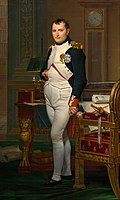
Napoleon — 1.68 m: 7 cm shorter than you.
Your silhouette: up and down arrows change the height by 1 cm, Page Up and Page Down by 5 cm
Photo: Wikimedia Commons
Where you stand among 2,000
Each bar is people of the same height in 2 cm steps. Left of your line — everyone shorter than you.
At 175 cm you are taller than 35% of the greats whose height is on record.
Height is recorded in Wikidata selectively: mostly for 20th-century athletes and politicians, men and women together. This is a line-up of celebrities, not the average height of an era.
Your height exactly — 175 cm


Findings


See also
More about bodies and time
- Birthdays of the greatsThe wheel of the year: on which days the famous were born and who shares your birthday
- How long the greats livedAge ridges by century and your own line: how many born in the 15th and the 20th century reached your age
- My life in historyWhich greats you have already outlived, who your peers are and what the world was like when you were 10, 18 and 30.
How we counted
Height is Wikidata property P2048; if there are several values, the first one is used. The backend returns up to 2,000 of the most famous people between 1.2 and 2.5 m; the “taller/shorter than you” share is computed over them, in whole centimetres.
Silhouettes share one scale and one set of proportions: figures differ only in height. The head is a portrait from Wikimedia Commons. “Height neighbours” are the most famous people whose height is closest to yours.
Your height stays in the browser and in the page address (`?h=`) so you can share it; it is not stored on the server.
Based on 200,862 people in our database. It is not the whole of Wikidata yet, only part of it, with more rulers, scientists and writers than ordinary people. The sample is skewed: read it as a sketch, not a law of nature.
This is a sample of our base, not all of history: Wikidata covers Europeans, men and the 19th–20th centuries best.
Data: Wikidata (CC0); portraits: Wikimedia Commons (each file has its own licence).