Stats of the greats · 03 of 08
Age of masterpieces
By age 36, 31% of the masterpieces in the database had been made. Half — before 42 years.
And you?
36years — your age
Drag the “you” line — the masterpieces light up
And you?
36years — your age
Made at 36
The best-known authors whose masterpiece came exactly at your age.
- 36van Gogh“The Starry Night” · 1889
- 36Poe“The Raven” · 1845
- 36Rembrandt“The Night Watch” · 1642
- 36Austen“Sense and Sensibility” · 1811
- 36Wilde“The Picture of Dorian Gray” · 1890
- 36Schrödinger“Schrödinger equation” · 1923
- 36Torvalds“Git” · 2005
- 36Verne“A Journey to the Centre of the Earth” · 1864
- 36Nolan“The Prestige” · 2006
- 36Kilmer“Batman Forever” · 1995
- 36Thompson“Sense and Sensibility” · 1995
- 36Stallman“GNU General Public License” · 1989
- 36O'Hara“Home Alone” · 1990
- 36Brown“Angels & Demons” · 2000


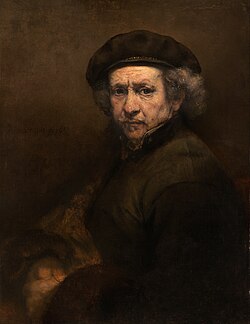


And 51 more at this age
Photo: Wikimedia Commons
What the swarm shows
Half the masterpieces — before 42 years
Left of the median — early strokes of luck; right of it — late summits.
Before 25 — 6% of masterpieces
Early strokes of luck are rare: most major works came between 30 and 50. Earliest: Anne Frank — “Diary of Anne Frank” at 13.
Earliest — “Science”: median 34 years
Field medians with at least 20 works: Science — 34, Literature — 41, Painting — 42, Music — 46 and Politics — 51.
See also
More from Stats of the greats
- How long the greats livedAge ridges by century and your own line: how many born in the 15th and the 20th century reached your age
- The 27 ClubDraw your guess first — then see whether geniuses really die at 27 more often
- Nobel PrizeHow old laureates were on the day of the prize — and how they keep getting older
How we counted
Wikidata works with a creation date and an author (P50/P170/P86); age is the year of creation minus the author’s year of birth, 5–100 and not after death. A work has at most three authors — otherwise it is a theory, not a masterpiece.
One dot is one work; an author may have several. Portraits go to the 140 most famous authors (one work each), everyone else is a dot in the field’s colour.
based on 2,000 people in the database
This is a sample of our base, not all of history: Wikidata covers Europeans, men and the 19th–20th centuries best.
Data: Wikidata (CC0); portraits: Wikimedia Commons (each file has its own licence).